Daily Cash Flow Control: A Practical Guide for Beauty Businesses
Learn how to record daily inflows and outflows in cash flow control and improve the financial management of your beauty business.

If someone had told me years ago that managing a beauty salon's cash register would be one of the greatest competitive advantages, I probably would have looked at them with suspicion. Over time, I came to realize that there is no stable management without clarity regarding money coming in and going out. Controlling resources on a day-to-day basis not only prevents unpleasant surprises, but also allows for quick decisions if something goes off plan. I believe that simplicity in daily financial control is what sustains prosperous businesses in the beauty industry.
This sector, by the way, does not stop growing. According to a recent projection, the global aesthetics market could break records and exceed 145 billion dollars by 2030, with annual growth of around 7%, and Brazil is consolidating its position among the largest consumers in the world. But this scenario of opportunities comes loaded with management challenges that go beyond customer service and marketing, as shown by a detailed analysis of beauty market projections, which could reach US$ 130 billion by 2026 alone, but still runs into internal obstacles, especially when it comes to managing money in the daily routine.. .
Throughout this guide, I want to share my vision, along with the experience of other professionals in the field, on the importance of daily cash control, not only in theory, but explaining what I do, how I record, best practices, and the most efficient features of Belasis for those who no longer want to waste time or money due to a lack of financial monitoring.
Why is daily cash control the foundation of stability in beauty businesses?
It is not rare to find beauty professionals who dedicate themselves entirely to customer service, take courses, invest in high-end products, but feel their "cash disappear" at the end of the day. I mentioned this once to the owner of a salon I frequent, and she replied immediately: "We earn the money, but the money disappears without daily control."
Controlling the balance daily is more than writing down numbers: it is about monitoring the business transactions in real time. Thus, it is possible to anticipate decisions, avoid debts, and quickly identify discrepancies, fraud, or drops in revenue.
“Taking care of the cash register out of habit is taking care of the business's health.”
Furthermore, keeping this continuous monitoring directly influences:
Error reduction: I have witnessed situations where, due to a lack of records, closing the month meant a "guess" of how much profit was made.
Agility in decision-making: By having the balance in the palm of your hand, it is simpler to reallocate resources, negotiate with suppliers, or plan promotions to stimulate sales in slower periods.
Reduction of losses: Common failures, such as forgetfulness, unrecorded withdrawals, or off-standard payments, become evident when everything is properly recorded.
Security in accountability: Anyone who needs to split profits or inform partners finds support in detailed cash control.
Managers in the beauty and aesthetics sectors who adopt this daily monitoring report more confidence in investment choices and less anxiety when closing the month. A benefit that, I confess, I felt in practice several times.
Understanding the difference between cash control and cash flow
Confusing these two concepts is extremely common, especially in businesses that are just starting out. I have made this mistake myself. Cash control refers to recording inflows and outflows of money on a given day, meaning it deals with the present state of the cash register. The goal is always to know how much physical and digital money is available at that moment.
Cash flow, on the other hand, is a broader view. It gathers all planned and realized financial movements within a certain period (week, month, quarter), helping to plan future expenses and identify periods of higher or lower demand.
Cash control: Total focus on the day-to-day, detailing every payment and receipt.
Cash flow: Allows looking forward, comparing what was planned with what was achieved in longer terms.
“Cash control looks at the now, cash flow looks at the future of the business.”
I understood this difference well when I needed to separate the daily payments from the scheduled accounts for the following month. Everything became clearer in the management of the salon I monitor. And Belasis, a platform that I recommend and use as a reference, helps to visualize these two dimensions independently and organized.
Step-by-step for daily recording: How to control incoming and outgoing movements?
In the beauty sector, every sale, extra service, commission, refund, or cash withdrawal must be recorded. I usually divide the balance control into simple daily steps:
Opening the cash register: Every morning, I start the procedure by checking the initial balance – the physical or digital money present at the start of the shift, including change.
Recording revenues: With each completed service (haircut, coloring, manicure, aesthetic packages), I immediately write down the amount received, specifying if it was in cash, card, or bank transfer.
Recording daily expenses: By the way, I don't leave it for the end of the day. As soon as I make a payment or withdrawal (purchases, extra change, small repairs), I enter it into the system.
Proof of outflows: I keep simple receipts or photos of the vouchers because, very often, the details prevent headaches later on.
Closing the cash register: I finish by checking the available balance, adding revenues, and deducting all expenses. The final amount must match exactly what is on hand (cash and card receipts in process).
This daily ritual allowed me to alert other managers when something was off-standard. And if the environment is busy, using a system like Belasis automates several steps, preventing typical omissions of a hectic routine.
How to avoid common mistakes when recording inflows and outflows?
It is not rare to see salons, clinics, and barbershops making very simple mistakes in financial control. In my experience, the most common errors are:
Mixing personal and business expenses, which causes confusion and can affect the company's financial health.
Recording revenues late, losing data accuracy and encouraging omissions or forgetfulness.
Not detailing the payment method, making it difficult to control card receivables and reconcile the balance at closing.
Forgetting to account for small daily expenses, which accumulate and affect the results.
Not periodically comparing the physical cash balance with the recorded balance.
“An error in recording a single service may seem minor today, but over the month it generates a significant difference.”
My valuable tip: take one minute for each transaction, preferably using your mobile phone, as Belasis offers this convenience. For those who prefer paper, keep an exclusive notebook, but never leave it for later. Recording everything at the moment it occurs eliminates rework and prevents fraud.
Best practices for opening, monitoring, and closing the cash register (with examples)
In the context of beauty, I adapted procedures so that controlling the balance would be quick but thorough. Here are the steps I suggested in salons and clinics I monitored:
Opening
Defining the initial amount: Always start with a fixed amount or close to it in the register, to facilitate comparisons and change throughout the day.
Recording the responsible person: Identify who started the shift, as shared responsibility makes control more reliable.
Monitoring during working hours
Entry at source: Each receipt/sale of product or service must be recorded instantly.
Record everything, including separate tips: Some teams fail to write down smaller amounts and "lose track" of part of the revenue.
If there is a team, perform intermediate checks: For example, before lunchtime and at the end of the shift, especially in high-traffic areas.
Closing the cash register
Careful verification: Add all receipts by category (cash, card, pix) and deduct expenses to arrive at the final balance.
Note discrepancies immediately: Any amount that does not match must be investigated on the spot.
Signature or confirmation of the responsible person upon closing: Generates accountability and deters intentional errors.
Keep receipts: Whether physical or digital – archiving simplifies future consultations.
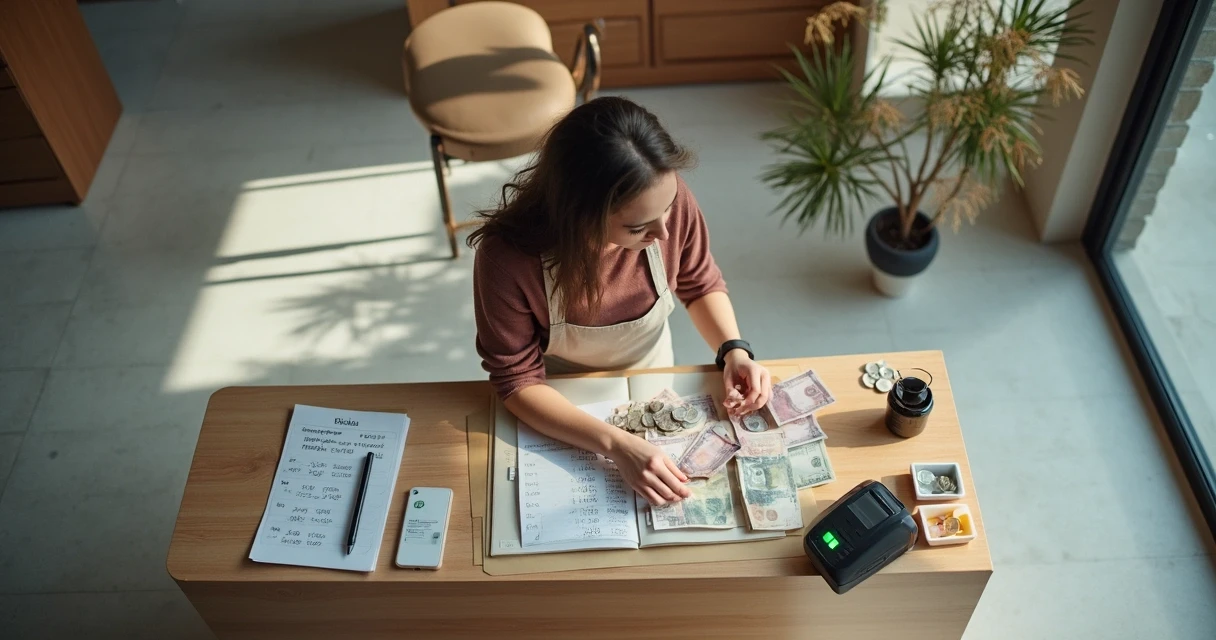
In one of my client's salons, after adopting these practices, reconciling the cash register became a natural habit, considerably reducing doubts and rework.
Tips for separating expenses and earnings, without confusing the business balance
Separating everything that is a salon or clinic expense from what belongs to personal life was a turning point in my understanding of financial management. I saw many professionals mixing everything up, and the consequences are always bad:
Difficulty in calculating the real profit.
Confusion in paying bills.
Even tax penalties.
My main recommendation is to create categories for your entries:
Revenues: Services, product sales, commissions (detailing type and origin).
Operating expenses: Rent, salaries, purchase of supplies, maintenance.
Partner withdrawals: If there are partners, record their withdrawals separately.
Personal expenses: Never enter items like groceries, trips, or personal payments into the business cash control.
“Financial organization begins by separating personal accounts from salon accounts.”
Using systems that allow expense classification, like Belasis, makes this automatic – simply choose the appropriate category for each entry.
Using automated systems: Why betting on Belasis makes a difference?
Working with paper and pen is possible, but risky, especially in teams that serve many clients at the same time. Systems like the Belasis platform facilitate and bring more security, because they automate most of the steps of daily control, reduce errors, send alerts, and still make it possible to reconcile everything with other management sectors.
I share some of my insights from monitoring the implementation of digital systems in beauty businesses:
Speed: With just a few taps, you can record sales, expenses, refunds, or extra entries.
Quick search: To find past transactions, simply search by date, amount, or category.
Automatic backup: Records are secure, do not depend on the state of physical paper, and can still be accessed remotely.
Report generation: Daily, weekly, or monthly financial reports allow you to analyze patterns and adjust the business direction quickly. Belasis offers easy-to-interpret and export reports, optimizing accounting tracking.
Multi-payment method control: The system automatically distinguishes between what comes in as cash, pix, debit, or credit, calculating the balance.
Integration with scheduling and customer database: The platform also unites scheduling, client registration, and other relevant information – all in one place.

I saw in practice how much automation reduces cash disputes, manual errors, and even small leakages. Everything is tracked, and the time saved can be used for what professionals love most: creating beauty and serving clients.
How to generate and interpret financial reports: Turning data into decisions in the salon, barbershop, or clinic
Financial reports are not just for the accountant; they are management tools that help to see patterns, identify losses, and correct courses of action. In the beauty businesses I monitored, the routine of checking reports at the end of the week became one of the main planning allies.
A good daily cash report gathers:
Total revenue by service or product category.
Detailed daily expenses.
Final balance of each shift.
Automatic comparison with previous days.
Alerts about discrepancies or sharp drops.
By observing the numbers, it became clear to me when and why there was a drop in profits, where expenses were unnecessarily high, or if it was timely to create promotions for slow hours. On more than one occasion, I identified invisible daily waste patterns in the reports, such as over-supplying materials or commissions that were out of standard.
In Belasis, report generation is instantaneous and allows detailing by professional, shift, or service type – which is especially useful for large teams or franchises.
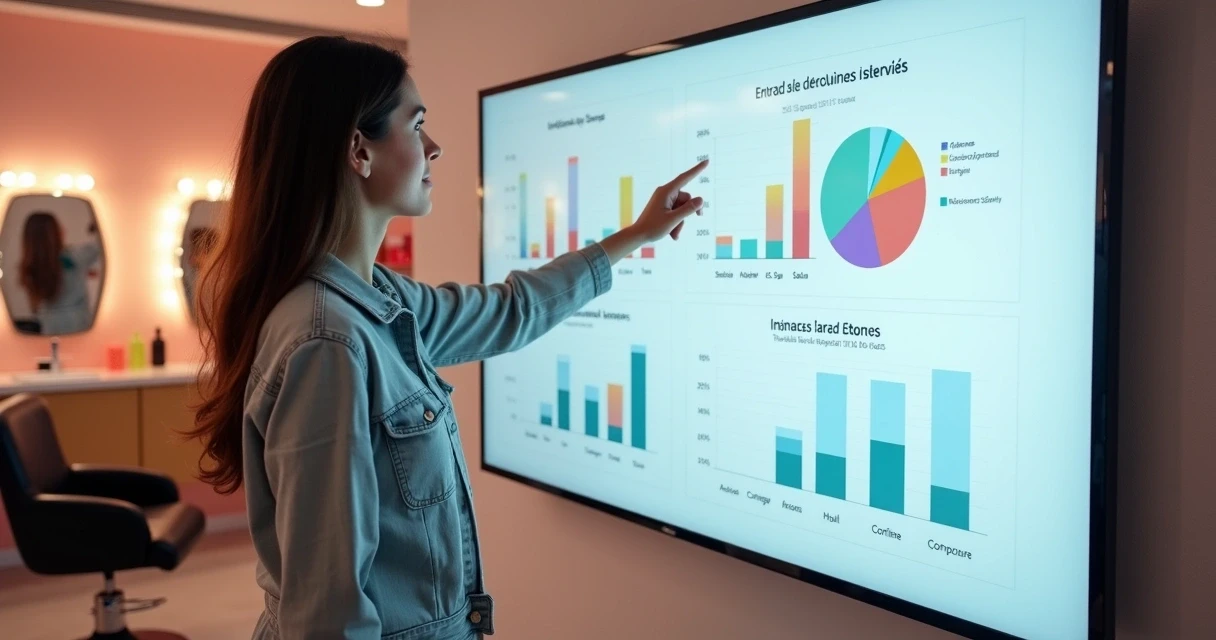
I suggest interpreting reports based on these questions:
What are the main times/revenue highlights of the business?
Do I have expenses that are out of standard or that could be reduced?
Any service sold below the target?
Is the cash balance healthy or declining? Why?
Are there records pending entry for the day?
When the answers are not clear, it is a sign to review processes or seek guidance – in fact, in the weekly reports generated by the Belasis system, these answers come in a visual and intuitive way.
How to control the available cash balance daily?
In my experience, the secret is simple and requires consistency. There is no magic: maintain daily monitoring without exceptions, even on the busiest days. I recommend using a control board or, if possible, Belasis digital charts, which show the updated balance throughout the day.

The main steps I follow and recommend to colleagues are:
Always check the initial value: Opening with registered balance.
Record each transaction immediately: Delaying leads to forgetfulness.
Compare the registered balance with physical cash: At the end of the shift, cash and entries must be identical – differences must be investigated and corrected.
Monitor payment methods separately: Cash, cards, pix, and transfers need to be checked with their respective receipts.
“A positive balance is not luck: it is daily discipline.”
By creating the habit of checking the balance, soon everything becomes easier, and errors drop drastically. Indeed, many reports from professionals I monitor reinforce this perception: regularity is the greatest ally.
Reducing losses: How to identify patterns that hurt your cash flow
Beauty businesses often lose money due to failures in processes and not because of external factors. When analyzing salons and clinics, I realized that the greatest losses were in small uncontrolled amounts, unauthorized discounts, poorly calculated materials, or leakages during slower hours.
With the help of detailed reports in Belasis or constant observation on paper, it is possible to:
Detect professionals who offer excessive discounts;
Locate low-profitability services;
Find "leaks" in operating expenses;
Identify increases in material use or purchases without justification;
Correct billing errors (services paid on the wrong day, duplicate payments, etc.);
In most situations, I corrected errors simply by rearranging tasks, reassigning responsibilities, or encouraging the team to record every single cent in the system. Over time, losses due to carelessness practically disappeared.

The secret lies in turning routine notes into clear indicators of where to intervene. If you notice a drop in revenue or an increase in expenses, investigate the details and promote training or talk to the team. A well-executed cash control opens space for transparency and improves the organizational climate.
Integration of financial control with scheduling, inventory, and customer service
If there is something I observed in the daily life of salons, it is that besides financial control, management only works if it integrates information with other sectors of the business. After all, it is from client scheduling and inventory management that a large part of the entries and exits arise.
Therefore, I recommend using systems that connect scheduling, available inventory products, and the cash register. Belasis, for example, unites everything on a single screen. This simplifies a lot:
Scheduling already informs the daily cash forecast.
Product sales are automatically deducted from inventory and entered into financials.
When receiving clients, it is already possible to record revenues and commissions for each service, detailing them in the same record.
Tracking defaulters also becomes faster.
The manager monitors the actual balance in real time, with alerts for discrepancies or delays in posting.
This integration helps ensure that the salon owner or manager doesn't need to duplicate tasks or lookups – everything is centralized, favoring control and decision-making. If you want to delve deeper into the relationship between financial management and other sectors, I invite you to access detailed content in the management category of our blog.
The impact of cash control on customer retention and salon growth
Few people realize how much financial organization and daily control directly influence customer experience and business growth. I share a notable case: an aesthetic clinic I helped monitor, upon adjusting cash control, was able to invest in timely promotions and loyalty programs without compromising cash flow. The result was immediate: an increase in customer frequency and a reduction in defaults, because all receipts were very clear and recorded.
“At the salon, balanced finances allowed reinvesting in training and new products.”
When financial monitoring is solid, customers perceive improvements in service and feel confidence. This, combined with a positive experience, results in referrals, returns, and an increase in the average ticket.
For those who want to see other winning strategies in the beauty business and how they handle similar challenges, I recommend reading the beauty category of our blog.
The role of cash control for those who work as freelancers
Freelancers in the beauty business, including hairstylists, barbers, and estheticians, sometimes feel that financial routines are excessive bureaucracy. In practice, I have seen stories of professionals who did not know if they were making a profit until the month they began to daily control their inflows and outflows.
With daily recording, it became visible where they could adjust service values and cut unnecessary expenses.
Visualizing the real balance allowed them to safely invest in advertising.
Even professionals without many clients realized how much they could set aside monthly to reinvest.
The secret is to separate "incoming money" from what actually remains available after each expense. No matter the size of the operation: discipline applies to freelancers and large businesses alike.
How to keep the team engaged and avoid conflicts in financial control?
If more than one person handles the cash, it is essential that everyone understands the importance of recording each piece of data with precision. The secret to maintaining engagement and avoiding friction is:
Explain the relevance of recording to all team members (and not just to the manager).
Delegate clear responsibilities and create a rotation system, if you find it necessary, to keep everyone attentive to the processes.
Perform group reviews, preferably during cash closing, so that doubts are resolved quickly.
Propose rewards or bonuses for error-free records over predefined periods.
“An aligned team avoids disputes and fraud at the cash register.”
In several salons I monitored, talking openly about cash and rewarding good results changed the atmosphere and increased trust among everyone.
Real cases: Results of efficient cash control in salons and clinics
When financial monitoring is done consistently, results appear within a few weeks. In a client's salon, daily control allowed detecting a peak of unplanned expenses – something that would have gone unnoticed without monitoring. After adjustments and negotiations with suppliers, costs dropped by about 12% in two months.
Another example I experienced was with a medium-sized aesthetic clinic. They faced problems with lack of cash to replenish inventory. The implementation of detailed control, combined with automation by Belasis, showed that small advances and out-of-schedule payments were the source of the problem. By changing processes, the company eliminated losses and managed to reinvest in marketing.

These stories show that practicing daily financial tracking can be simple and transformative for any business. It is not just about avoiding losses, but about seizing opportunities and growing.
Quick and recurring tips to strengthen control on a daily basis
Establish fixed times for recording and checking: get used to posting everything at defined moments, such as before breaks and at closing.
Instruct the team not to mix cash register money with personal expenses under any circumstances.
Keep all daily receipts visible: until they are checked and archived, keep them in a specific envelope or box.
Update prices of services and products regularly, to avoid "leaks" in the cash register.
Use apps, like Belasis, to alert you about pending entries or balance discrepancies.
Perform weekly reviews of records to identify patterns and correct flaws quickly.
Remembering that other tips and methods can be found in the finance category of our blog.
The role of financial control in talent retention and team well-being
It is of no use to improve cash flow if the team is dissatisfied or insecure about their own payments. With well-managed control, planning bonuses, paying commissions fairly, and even advancing payments on holidays becomes simple – this has always brought better results in the projects I monitored.
Moreover, a transparent environment guarantees more trust and stability, reduces conflicts, and improves team productivity. Belasis offers practical tools for this, integrating commission payments and tracking everything in the same dashboard.
If you want to get inspired by other retention models in the field, it is worth looking at experiences from other businesses in publications like this one about talent retention benefits and also in content about the team's quality of life.
Conclusion: Daily control is the bridge to growth and peace of mind
Throughout my journey in the beauty sector, I learned through trial and error that monitoring cash movements, even if it seems bureaucratic, is the bridge for businesses to move forward and gain stability. The secret lies less in the complexity of tools and more in the regularity of records and the clarity of information.
Simplify the process. Prefer integrated systems, like Belasis, which offer everything from easy recording to complete reports in a few taps. With this, there is time left for what really matters: innovating, serving clients, and investing where it makes a difference.
“Financial control is not just about money, it is about peace of mind, growth, and the future.”
If you want to try new ways of control, test innovative features, and transform the financial routine of your beauty business, I invite you to discover Belasis. We have exclusive solutions for those who want convenience, safety, and sustainable growth. Be part of a new generation of successful managers in the sector!
Frequently asked questions about daily cash control in beauty businesses
What is daily cash control?
Daily cash control is the monitoring of the business's inflows and outflows of money in real time, throughout each day. It ensures that the physical and digital balance of the register is always recorded, allowing you to identify differences, correct errors quickly, and make decisions based on updated information. This routine is essential for beauty salons, barbershops, and aesthetic clinics, as it prevents losses and brings clarity to financial management.
How to do cash control in a salon?
To control the salon's cash, the first step is to record the initial amount of the day and, with each transaction (revenues or expenses), write down the values immediately. I recommend using systems that categorize inflows (by services, products, tips) and outflows (purchases, salaries, maintenance), keeping receipts organized. At closing, check if the physical balance matches the recorded one. Using a platform like Belasis automates this process, making it safer and more agile.
Why control my business's cash?
Controlling cash is essential to avoid losses, quickly detect financial problems, identify consumer patterns and customer behavior, and ensure that all revenues and expenses are well detailed. This brings security, allows planning promotions and investments with more certainty, avoiding negative surprises and promoting business growth.
What mistakes to avoid in financial control?
The main mistakes to avoid are mixing personal expenses with business ones, recording transactions late, not detailing the payment method, forgetting small entries, and not regularly checking the physical balance against the recorded cash. Furthermore, leaving everything to be checked only at the end of the month harms the accuracy of information and can mask structural problems.
Is there an app for cash control?
Yes, there are apps like Belasis, developed especially for beauty businesses, which allow you to manage cash control through a mobile phone, tablet, or computer. These tools bring convenience, safety, automatic reports, and integration with scheduling and customer management, making the daily life of managers and freelancers much easier.
Share